Figure 1: A professional using a click-type torque wrench to torque wheel lug nuts
A torque wrench is one of the most important tools in any mechanic's collection. It allows you to tighten bolts and fasteners to a precise, specified torque value — preventing both the dangers of under-tightening (loose bolts) and over-tightening (stripped threads, cracked components, or warped surfaces).
This guide covers everything you need to know: the internal kinematics of different torque wrenches, step-by-step setup guides, adapter calculations, DIY calibration, and common errors to avoid.
1. Detailed Kinematics of Torque Wrenches
Before using a torque wrench, understanding the mechanics of how the tool registers rotational force helps prevent errors in the field:
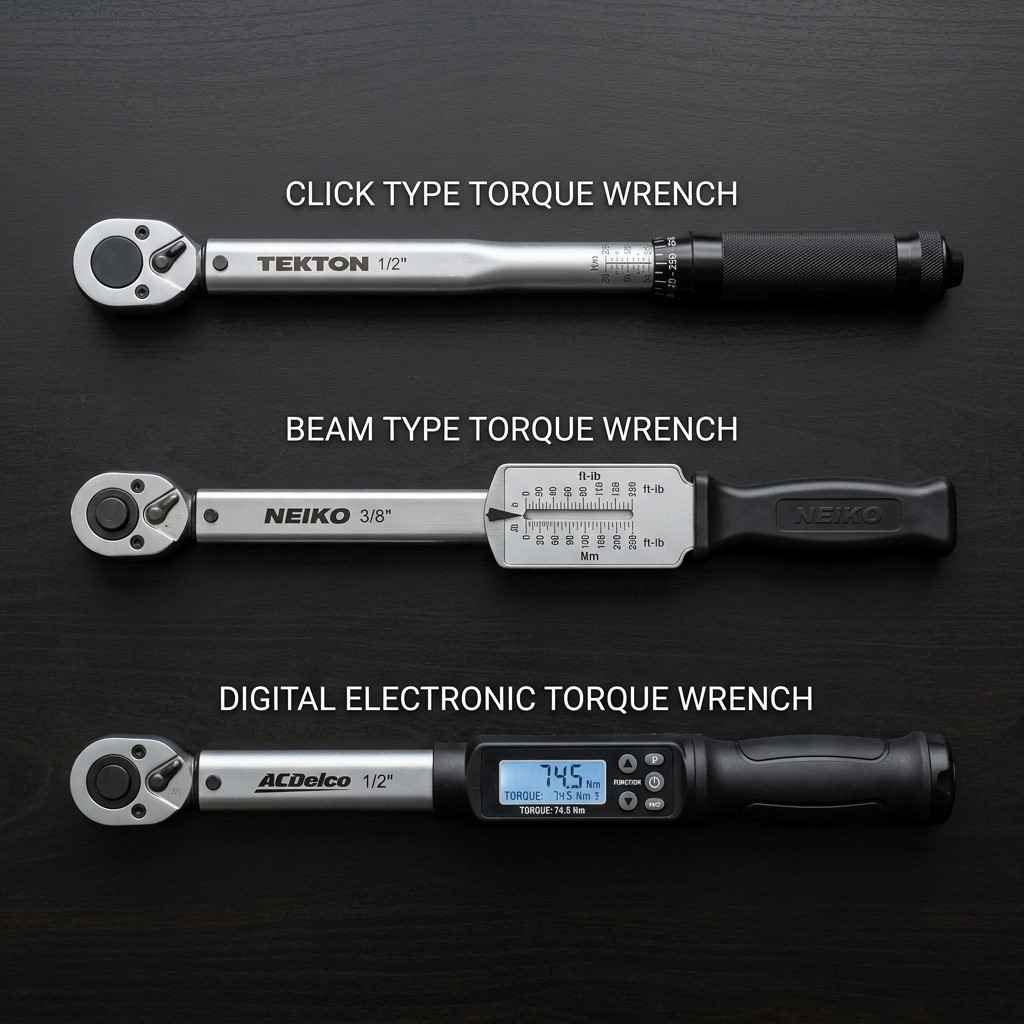
Click-Type (Micrometer)
Mechanism: Houses a calibrated spring under compression that pushes a hardened roller against a pivoting block. When the rotational force exceeds the spring's compression force, the block slips off the roller and strikes the steel wall of the handle, producing a distinct audible click and physical release.
Beam-Type
Mechanism: Operates on pure material elasticity. It features two beams: a main bending beam that deflects under load and a secondary indicator beam that remains completely straight. A scale at the handle base measures the deflection distance. It has no moving internal spring parts.
Digital Electronic
Mechanism: Integrates a solid-state strain gauge bonded to the wrench flex shaft. The gauge experiences electrical resistance changes when under tension, which a microprocessor converts to a digital torque reading. It alerts the user via buzzers, LEDs, or vibration motor patterns.
Dial Indicator Type
Mechanism: Translates drive shaft deflection through a mechanical gear rack to a dial indicator pointer. It features a memory needle that remains at the peak torque value achieved during the pull.
2. Step-by-Step Operating Guide (Click-Type Wrench)
Consult Fastener Specifications
Identify the manufacturer's target spec in N·m, lbf·ft, or lbf·in. Never guess these values. If your wrench scale uses a different unit system, convert the values using our free torque converter to avoid mathematical errors.
Inspect Wrench Sizing limits
For maximum accuracy, select a wrench where the target spec falls between 20% and 80% of the scale limit. Standard mechanical springs are less accurate at the absolute minimum and maximum zones of their range.
Unlock and Set the Scale
Loosen the locking collar or knob at the bottom handle shaft. Rotate the handle to align the primary target numbers on the vertical barrel. Fine-tune the decimal values using the horizontal rotating collar. Lock the handle collar securely before applying force.
Clean and Hand-Thread Fasteners
Clean the bolt threads and mounting surfaces. Thread the bolt by hand to ensure it is not cross-threaded. Drive the bolt until the joint is snug (finger-tight) before applying the torque wrench.
Position Your Hand on the Wrench Handle
Grip the handle precisely at the marked center point. Do not slide your hand up the shaft or use handle extensions. The wrench calibration relies on a specific distance (lever arm) between your hand and the fastener center line.
Apply Smooth, Steady Rotational Pull
Pull the wrench smoothly in a single continuous plane. Avoid jerking or applying quick, snapping forces. Jerking adds dynamic kinetic momentum, causing the bolt to over-torque before the mechanical click release activates.
Stop Immediately at the Click
As soon as you hear or feel the click release, stop pulling immediately. The tool has reached its set limit. Continuing to turn the handle past the click overrides the safety limit and over-torques the joint.
Relax the Spring setting for Storage
Before putting the wrench away, unlock the collar and wind the handle down to its lowest marked scale value. This relieves tension on the internal spring, preventing spring fatigue and preserving calibration accuracy over time.
3. Adjusting Settings for Crowfoot and Adapter Extensions
If you add an adapter (such as a crowfoot wrench) that extends the physical length of the torque wrench, you alter the leverage. This results in the fastener experiencing more torque than what is set on the handle dial. You must calculate a corrected torque setting:
Note: If the adapter is placed at a 90-degree angle to the wrench axis, the effective length remains unchanged (E = 0), and no adjustment calculation is necessary.
4. DIY Torque Wrench Calibration Verification
If you suspect your click-type wrench is out of calibration, you can perform a static gravity check at home using a vice, a known weight, and a tape measure:
- Secure the square drive of the wrench in a bench vice with the wrench body extending horizontally.
- Measure the exact distance (L in feet or meters) from the center of the square drive to the center line of the handle grip.
- Hang a known weight (W in pounds or kilograms) from the center of the handle grip.
- Multiply the weight by the distance:
• Imperial: Torque = W (lbs) × L (ft)
• Metric: Torque = W (kg) × L (m) × 9.81 - Adjust the handle dial to match this calculated torque value. The wrench should click right when the weight is fully suspended. If it clicks early or late, the wrench is out of calibration.
5. Frequently Asked Questions
Is it okay to "double click" a bolt?
No. Clicking the torque wrench multiple times on the same fastener is a bad practice. The second pull typically applies additional static friction resistance, causing you to over-torque the bolt by 10% to 15% before the click registers again.
Can I use a torque wrench to break loose stuck bolts?
Never. Using a torque wrench as a disassembly tool or breaker bar is a common way to ruin its calibration. The internal pivot mechanism can easily slip or yield, damaging the tool. Always use standard ratchets or breaker bars for loosening tasks.
How does lubricating a thread affect the torque spec?
Unless specified by the manufacturer, torque specs are written for clean, dry threads. Applying grease, oil, or anti-seize reduces thread friction. If you torque a lubricated bolt to a dry specification, you will over-stretch the bolt shank, which can snap the fastener or strip the internal threads.