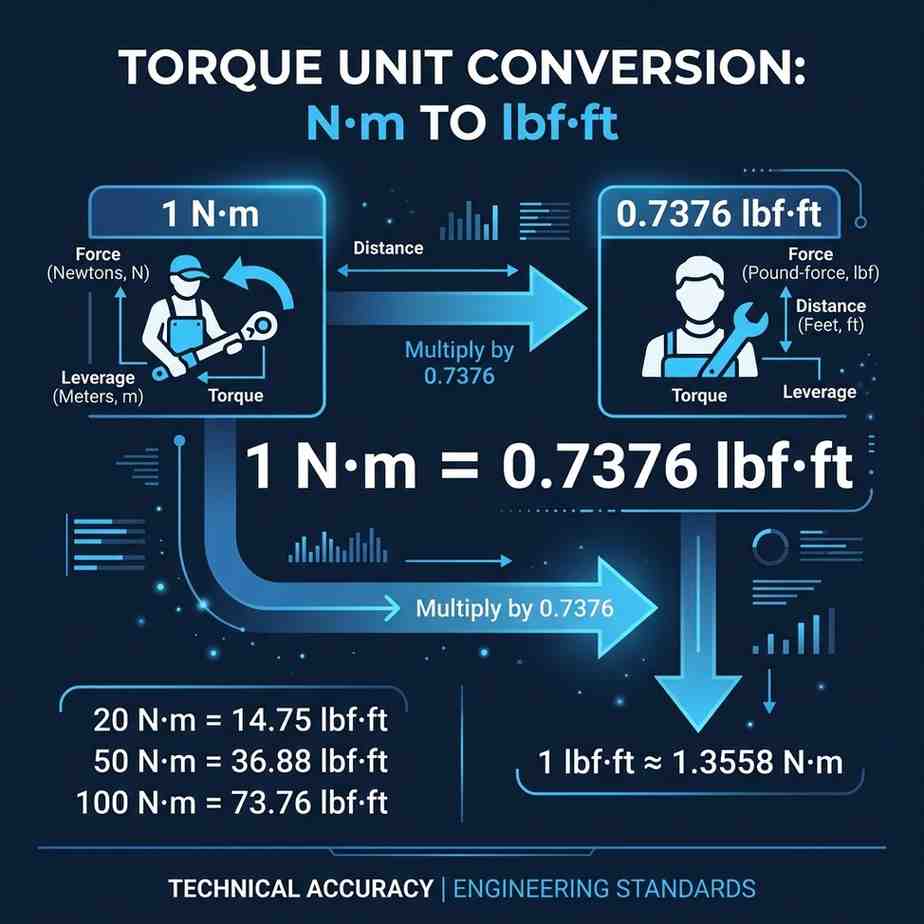
Figure 1: Visual overview of the N·m ↔ lbf·ft conversion relationship
If you work in automotive engineering, mechanics, or any technical field that crosses international borders, you've almost certainly needed to convert Newton-meters (N·m) to pound-force feet (lbf·ft) — or vice versa. This conversion is one of the most common in all of engineering practice.
This guide gives you the exact formula, scientific derivation of the conversion coefficients, reference tables, worked examples, and the most common mistakes to watch out for. By the end, you'll be converting between these units confidently — and you can always use our free torque calculator to verify your results.
1. The Scientific Derivation of the Conversion Factor
To understand where these conversion factors come from, we must look at how the basic units are defined by the National Institute of Standards and Technology (NIST):
- 1 Meter (m) is defined in terms of the speed of light. Under standard conversion systems, exactly 1 foot (ft) = 0.3048 meters.
- 1 Newton (N) is the SI unit of force, defined as the force needed to accelerate 1 kilogram of mass at a rate of 1 meter per second squared (\(1\text{ kg·m/s}^2\)).
- 1 Pound-force (lbf) is the Imperial unit of force, representing the gravitational pull on a 1-pound mass at standard Earth gravity. Exactly 1 lbf = 4.4482216152605 Newtons.
By multiplying these standard coefficients together, we derive the exact relationship between one pound-force foot and one Newton-meter:
1 lbf·ft = 4.4482216152605 N × 0.3048 m = 1.3558179483314 N·m
For convenience and daily calculations, engineers round this factor to 6 decimal places:
To find the inverse conversion factor (converting N·m to lbf·ft), we divide 1 by our coefficient:
\(\frac{1}{1.3558179483314} \approx 0.737562149277\) lbf·ft
2. Quick Reference Conversion Table
Here are the most commonly needed conversions between N·m and lbf·ft, mapped to their mechanical applications:
| Newton-meter (N·m) | Pound-force foot (lbf·ft) | Pound-force inch (lbf·in) | Common Engineering Application |
|---|---|---|---|
| 5 N·m | 3.69 lbf·ft | 44.25 lbf·in | Bicycle carbon handlebars, electronics casings |
| 15 N·m | 11.06 lbf·ft | 132.76 lbf·in | Spark plugs (aluminum heads), plastic intake manifolds |
| 30 N·m | 22.13 lbf·ft | 265.52 lbf·in | Oil filter canisters, valve cover bolts, transmission pans |
| 100 N·m | 73.76 lbf·ft | 885.07 lbf·in | Standard passenger car wheel lug nuts |
| 140 N·m | 103.26 lbf·ft | 1,239.10 lbf·in | SUV and light truck wheel lug nuts |
| 250 N·m | 184.39 lbf·ft | 2,212.69 lbf·in | Front axle hub nuts, engine flywheel mounting bolts |
| 500 N·m | 368.78 lbf·ft | 4,425.37 lbf·in | Heavy commercial truck wheel studs, structural steel bolts |
3. Step-by-Step Worked Examples
🚗 Example A: European Wheel Lug Torque Specs
A German sedan service manual specifies wheel lug bolt torque as 130 N·m. Your American torque wrench only has a scale calibrated in foot-pounds (lbf·ft). What should you set the wrench dial to?
Step 1: Identify the conversion direction. We are converting from N·m to lbf·ft, so we multiply by 0.737562.
Step 2: Execute the multiplication:
Torque = 130 N·m × 0.737562 = 95.883 lbf·ft
You should set your torque wrench to 96 lbf·ft.
🔩 Example B: Heavy Duty Truck Cylinder Head
An American heavy-duty engine head bolt spec calls for 165 lbf·ft of torque. You are using a European digital torque wrench calibrated in Newton-meters (N·m). What value must you program?
Step 1: We are converting from lbf·ft to N·m, so we multiply by 1.355818.
Step 2: Execute the multiplication:
Torque = 165 lbf·ft × 1.355818 = 223.71 N·m
You should set the digital wrench tool to 224 N·m.
📐 Example C: Low-Torque Precision Fasteners
A miniature sensor casing specifies a torque of 3 N·m. You have a dial torque screwdriver measured in pound-inches (lbf·in).
Step 1: Since 1 lbf·ft = 12 lbf·in, the conversion multiplier is 8.850746:
lbf·in Multiplier = 0.737562 × 12 = 8.850746
Step 2: Multiply the value:
Torque = 3 N·m × 8.850746 = 26.55 lbf·in
Set the dial screwdriver to 26.5 lbf·in.
4. Why This Conversion Matters in Practice
The N·m vs. lbf·ft divide is largely a regional standard issue. American manufacturers and manuals traditionally specify pound-force feet, while European, Japanese, and international ISO standards use Newton-meters. When working with imported equipment or following international procedures, converting accurately is a critical safety item.
Getting this conversion wrong can lead to severe mechanical damage. Under-torquing allows fasteners to back out under vibration, which can lead to catastrophic joint failure. Over-torquing stretches bolts past their elastic yield points, leading to stripped threads, deformed flanges, or snapped bolt shanks.
5. Frequently Asked Questions
Is it "foot-pounds" or "pound-feet"?
Technically, pound-foot (lbf·ft) is the correct scientific term for torque (force at a perpendicular distance). Foot-pound (ft-lb) is the traditional unit of work or energy (mass lifted over a distance). While mechanics frequently say "foot-pounds" out of habit, "pound-feet" is the correct term for rotational force.
How do you quickly estimate the conversion in your head?
For a quick approximation, remember that N·m represents a slightly smaller value than foot-pounds. So, the number in N·m is always larger than lbf·ft. You can approximate N·m by multiplying the foot-pounds value by 4/3 (1.33), or approximate lbf·ft by multiplying the N·m value by 3/4 (0.75). For example, 100 N·m is roughly 75 lbf·ft (actual is 73.76 lbf·ft).